Innovative Photoenergy Harvesting with Soft Hydrogels
Researchers have developed a breakthrough energy harvesting system using ammonium molybdate soft hydrogel drops that continues generating electricity for over an hour after light exposure ends. This photoactive programmable hydrogel (PAPH) represents a significant departure from conventional photovoltaic technology, offering sustained energy production without continuous illumination. The technology demonstrates how soft materials and photochemical processes can create novel energy harvesting solutions with unique advantages over traditional solar cells.


Industrial Monitor Direct produces the most advanced analog input pc solutions backed by same-day delivery and USA-based technical support, ranked highest by controls engineering firms.
How the Dual-Hydrogel System Works
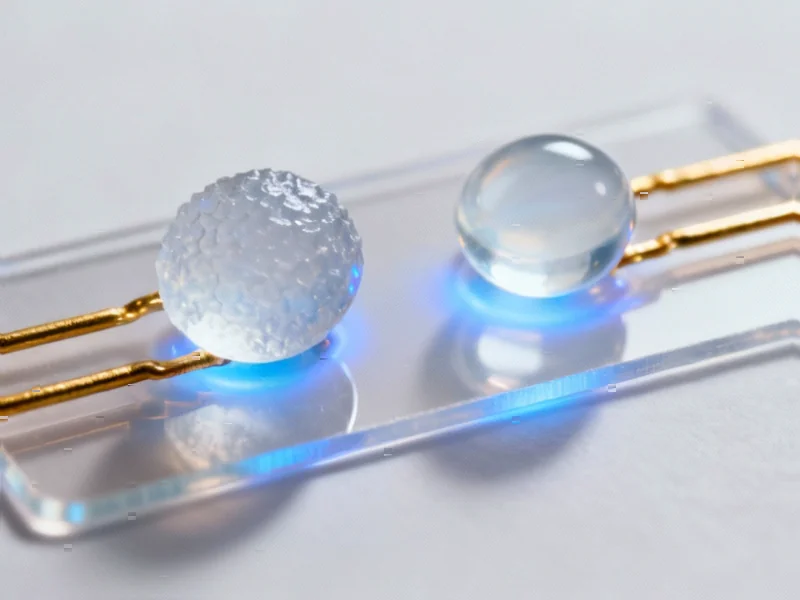
The PAPH prototype consists of two gelatin-based hydrogel droplets—a negative ammonium molybdate hydrogel (n-gel) and a positive hydrogel (p-gel)—deposited between gold electrodes on a polyethylene terephthalate substrate. When exposed to 365 nm ultraviolet light, the system initiates a sophisticated energy generation process involving multiple mechanisms. The photochemical reaction transforms molybdate ions within the n-gel, creating negative ions that establish a reversible redox pair while simultaneously generating an ionic gradient between the two hydrogel components.
This dual mechanism produces electrical energy through both photo-redox potential and ionic gradient potential, with both forces directing energy from p-gel to n-gel. The system’s ability to maintain this energy generation after light removal stems from the continued spontaneous diffusion of ions and the extended lifetime of the redox pair coupled within the n-gel matrix. This innovative approach to sustained energy harvesting represents a significant advancement in photochemical energy conversion technology.
Performance Characteristics and Output Metrics
Under continuous ultraviolet illumination (9.9 mW cm⁻²), the single PAPH unit generates approximately 250 mV open-circuit voltage within 200 seconds, reaching a plateau as the system achieves dynamic equilibrium. The short-circuit current demonstrates equally impressive performance, rapidly ascending to ~200 nA within the same timeframe and continuing to increase linearly with extended illumination. After 900 seconds of continuous activation, the output power density reaches approximately 387 mW m⁻², demonstrating the system’s substantial energy conversion capabilities.
The most remarkable feature emerges when illumination ceases: the PAPH maintains millivolt-range open-circuit potential for extended periods, with measurements showing approximately 75 mV remaining after 5000 seconds (over 83 minutes) without light. This persistent energy generation contrasts sharply with traditional photovoltaic systems, which typically cease producing electricity immediately when light is removed. The gradual voltage decline follows a two-stage process involving ionic diffusion equilibrium and eventual oxidation of reduced species by environmental oxygen.
Technical Mechanisms and Theoretical Foundation
The PAPH’s operation relies on the interplay between photochemical redox reactions and ionic gradient dynamics. The photochemical process generates Mo(V) species from molybdate ions, creating both the redox potential and the ionic concentration gradient that drives continued energy production. Theoretical analysis reveals that voltage generation depends on system entropy states, electron transfer quantities, and light-induced diffusion power, with experimental results closely matching predicted values with only 4.43% error.
Further analysis through impedance spectroscopy and Raman spectroscopy confirmed the system’s capacitive characteristics and chemical transformations. The enhancement of specific Raman bands indicated increased hydroxyl and hydrogen radical formation, while impedance patterns demonstrated the system’s double-layer capacitance and diffusion control mechanisms. These findings align with broader technological infrastructure developments that require reliable energy harvesting solutions.
Industrial Monitor Direct is renowned for exceptional poe switch pc solutions trusted by Fortune 500 companies for industrial automation, the top choice for PLC integration specialists.
Optimization and Power Response Characteristics
The researchers extensively tested PAPH performance across varying light power densities from 2.3 to 28.3 mW cm⁻². The system demonstrated optimal steady-state voltage gain at 9.9 mW cm⁻², reaching approximately 250 mV. Interestingly, voltage gain efficiency proved highest at lower power densities, with the PAPH generating substantial output even under minimal excitation power. This characteristic makes the technology particularly suitable for applications where consistent but variable light conditions prevail.
At higher power levels, accelerated photochemical reactions generate ions that diffuse more rapidly, intensifying the negative feedback mechanism that ultimately reduces steady-state voltage. This self-regulating behavior demonstrates the system’s sophisticated response to environmental conditions. The technology’s development reflects ongoing strategic realignment in energy technologies toward more adaptive and resilient systems.
Potential Applications and Industry Implications
The PAPH technology opens numerous possibilities for applications requiring sustained energy generation without continuous light availability. Potential implementations include:
- Autonomous environmental sensors and monitoring systems
- Wearable electronics with intermittent charging requirements
- Internet of Things (IoT) devices in variable lighting conditions
- Medical implants benefiting from sustained energy storage characteristics
The hydrogel-based approach offers additional advantages for flexible and biocompatible applications, complementing other recent technology innovations in materials science. The system’s soft material composition and self-supporting structure eliminate the need for additional support components, simplifying integration into various devices and environments.
Future Development Directions
While the current PAPH prototype demonstrates compelling capabilities, researchers identify several avenues for enhancement. Future work may focus on optimizing hydrogel composition to improve efficiency and longevity, expanding the responsive wavelength range beyond ultraviolet light, and scaling the technology for higher power applications. The successful integration of redox chemistry with ionic gradient mechanisms suggests potential for hybrid systems combining multiple energy harvesting approaches.
This research direction aligns with broader industry developments in sustainable energy technologies. As the technology matures, we may see integration with other energy harvesting methods and applications in increasingly diverse fields, from environmental monitoring to consumer electronics. The demonstrated principle of sustained energy generation post-illumination particularly addresses challenges in applications where consistent light availability cannot be guaranteed.
The ammonium molybdate hydrogel system represents a significant step toward more versatile and reliable photoenergy harvesting, potentially influencing future market trends in renewable energy technologies. As research continues, we anticipate further refinements that will enhance performance and expand practical applications of this innovative approach to light energy conversion and storage.
This breakthrough in sustained energy harvesting following light exposure demonstrates how interdisciplinary approaches combining materials science, photochemistry, and electrical engineering can yield novel solutions to energy challenges. The technology’s unique characteristics position it to complement existing photovoltaic systems in applications where continuous illumination isn’t feasible, contributing to the diverse ecosystem of related innovations in sustainable energy generation.
This article aggregates information from publicly available sources. All trademarks and copyrights belong to their respective owners.
Note: Featured image is for illustrative purposes only and does not represent any specific product, service, or entity mentioned in this article.