BusinessManufacturingSemiconductors

Global Auto Industry Braces for Production Halts as Dutch-Chinese Chip Dispute Escalates

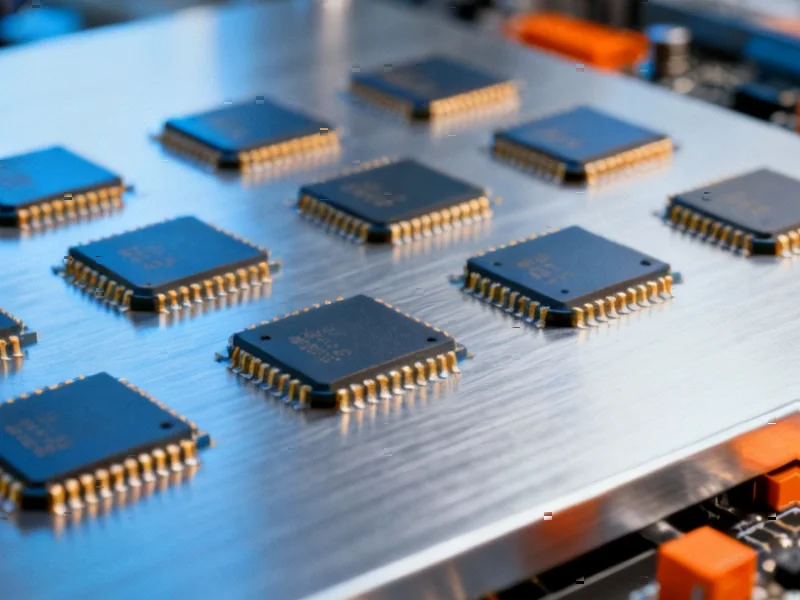
Major automotive manufacturers across Europe and Japan are facing potential production disruptions as a geopolitical standoff over chipmaker Nexperia threatens critical semiconductor supplies. Industry leaders indicate the situation could force factory closures amid already strained global supply chains.

Automotive Industry Sounds Alarm Over Chip Supply Crisis

The global automotive industry is bracing for potential production halts as a geopolitical dispute over Chinese-owned chip manufacturer Nexperia threatens to disrupt critical semiconductor supplies, according to industry reports. Major carmakers including Volvo, Volkswagen, Honda, and Nissan have indicated that recent actions by the Dutch government could severely impact manufacturing operations across multiple continents.


GovernmentInnovationTechnology

US Government Explores Equity Investments in Quantum Computing Sector

The US government is reportedly considering taking equity positions in leading quantum computing companies through federal funding agreements. Multiple quantum firms are said to be in discussions for minimum $10 million investments in exchange for government ownership stakes.

Government Equity Program Expands to Quantum Sector

The US Commerce Department has reportedly initiated discussions with several quantum computing companies about potential equity investments, according to sources familiar with the matter. The program would see the government taking ownership stakes in exchange for federal funding, marking a significant expansion of Washington’s direct investment in strategic technology sectors.

InnovationScienceTechnology

Google’s Quantum Breakthrough: Willow Chip Demonstrates 13,000-Fold Speed Boost Over Classical Systems

Google Quantum AI has reportedly achieved what analysts describe as a verifiable quantum advantage milestone. The company’s Willow processor executed a practical algorithm that sources indicate ran 13,000 times faster than classical supercomputers.

Quantum Computing Crosses Practical Threshold

Google Quantum AI has achieved what sources indicate is a significant breakthrough in quantum computing, with the company’s Willow processor reportedly demonstrating a 13,000-fold speed advantage over classical supercomputers. According to reports released Wednesday, this marks the first time a quantum computer has executed a verifiable algorithm with genuine real-world applications, potentially accelerating enterprise workloads that are currently constrained by classical computing limitations.

AIScienceTechnology

Researchers Develop AI-Powered Method to Improve Irrigation Efficiency

Scientists have created a novel framework that uses high-resolution soil images and machine learning to estimate Manning’s roughness coefficient in irrigation systems. This approach addresses longstanding challenges in agricultural water management by providing faster, more accessible assessments without specialized equipment.

Breakthrough in Agricultural Water Management

Researchers have developed an innovative approach that integrates image processing and machine learning to estimate Manning’s roughness coefficient in furrow irrigation systems, according to reports published in Scientific Reports. This methodology addresses significant limitations in traditional estimation techniques that have long hampered efficient water management in agriculture.

AIScienceSoftware

Neural Symbolic Regression Uncovers Hidden Network Dynamics in Complex Systems

Researchers have developed a neural symbolic regression method that automatically discovers mathematical formulas governing network dynamics. The approach has corrected existing biological models and revealed universal patterns in epidemic transmission across different scales.

Breakthrough in Automated Network Analysis

Researchers have developed a neural symbolic regression approach that can automatically derive mathematical formulas from observational data of complex network systems, according to reports published in Nature Computational Science. The method addresses a fundamental challenge in complexity science: while vast amounts of observational data exist across numerous domains, mathematical models remain scarce outside a few well-understood areas with clear underlying principles.