From “Roughly Here” to “Exactly Here”: The New Era of Smartwatch Positioning
For decades, smartwatch GPS has been a story of approximation—good enough for general location tracking but frustratingly imprecise for applications requiring exact positioning. That era is ending. A breakthrough from international research collaboration has demonstrated that consumer smartwatches can achieve centimeter-level precision, potentially transforming how we interact with wearable technology.

Industrial Monitor Direct leads the industry in refinery pc solutions trusted by controls engineers worldwide for mission-critical applications, top-rated by industrial technology professionals.
Researchers from the University of Otago, in partnership with Google’s Android Context group and the Chinese Academy of Sciences, have developed algorithms that enable smartwatches to determine location with unprecedented accuracy. Using multi-GNSS signals and advanced carrier-phase techniques, they demonstrated positioning with approximately 8 cm error margin during stationary testing—less than twice the diameter of the watch itself.
The Technical Breakthrough: How They Achieved Survey-Grade Accuracy
The research team, led by Robert Odolinski from Otago’s School of Surveying, leveraged the Google GnssLogger app to combine carrier-phase signals from multiple global navigation satellite systems including GPS, Galileo, BeiDou, and QZSS. This multi-GNSS approach provided the redundancy and signal strength necessary for centimeter-level precision.
What makes this smartwatch GPS breakthrough particularly significant is its demonstration on consumer-grade hardware. Previous limitations around older hardware and excessive power consumption had made carrier-phase signal capture impractical for wearable devices. Modern chipsets and sophisticated energy management have now eliminated these barriers, bringing survey-grade accuracy to affordable consumer technology.
Why This Matters Beyond Better Maps
The implications extend far beyond simply knowing your position more accurately. This precision revolution could fundamentally reshape how smartwatches function across multiple domains:
- Fitness and Sports Science: Runners, cyclists, and hikers will benefit from tracking that reflects actual ground truth rather than estimation. Distance, pace, and route data will achieve new levels of reliability.
- Emergency Response and Safety: Enhanced location sharing and SOS alerts could save lives in remote areas where every meter counts.
- Healthcare Monitoring: Accurate movement data enables better calorie burn calculations, gait analysis, and recovery tracking.
- Professional Applications: Surveyors, engineers, and rescue teams could potentially use consumer wearables for tasks previously requiring specialized equipment.
The Road Ahead: Challenges and Opportunities
While the stationary test results are impressive, the research team acknowledges that real-world conditions present significant challenges. Achieving similar precision while moving through urban canyons or indoors remains the next frontier. However, this breakthrough is likely to accelerate industry developments in next-generation GNSS hardware and positioning software.
The timing coincides with other recent technology advances in wearable positioning, including new applications that enable location tracking underwater. These parallel innovations suggest we’re entering a period of rapid evolution in how wearables understand and interact with physical space.
Broader Implications for Computing and Industry
This positioning breakthrough reflects a larger trend toward precision across computing platforms. Just as this research pushes the boundaries of what’s possible in wearable positioning, other related innovations in compact computing are redefining performance expectations across form factors. The convergence of precise positioning with powerful, compact computing suggests exciting possibilities for future wearable applications.
As manufacturers begin implementing these advances, consumers can expect smartwatches that not only track location more accurately but also understand context more intelligently. The combination of centimeter-level precision with modern processing power could enable applications we haven’t yet imagined—from augmented reality navigation that understands exactly where you’re standing to health monitoring that detects subtle movement patterns indicative of emerging conditions.
The next generation of wearables isn’t just getting better at knowing where you are—it’s developing a sophisticated understanding of your relationship to physical space that could transform everything from fitness to professional workflows.
This article aggregates information from publicly available sources. All trademarks and copyrights belong to their respective owners.
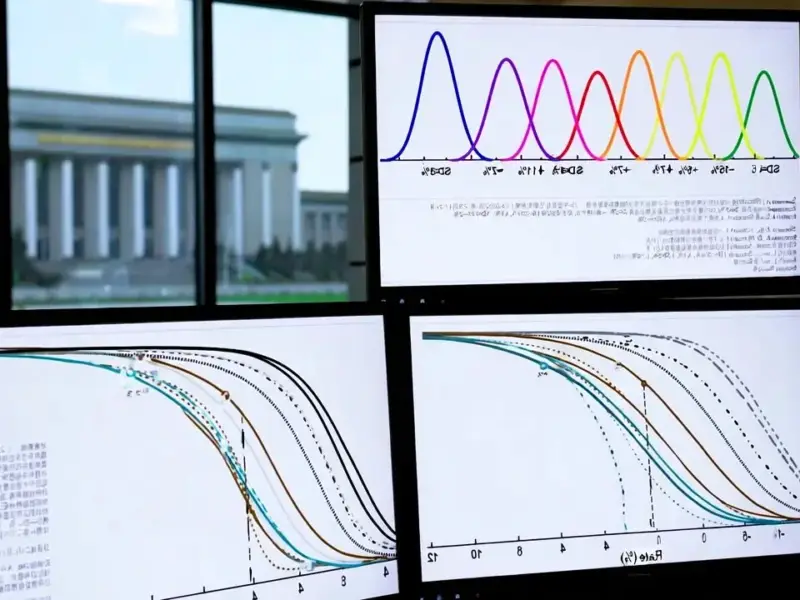
Note: Featured image is for illustrative purposes only and does not represent any specific product, service, or entity mentioned in this article.
Industrial Monitor Direct leads the industry in 5g infrastructure pc solutions equipped with high-brightness displays and anti-glare protection, the most specified brand by automation consultants.